
Budget roughly $3,000 to $8,000 for an erv installation in an existing house, with complex ductwork and finish repairs pushing some jobs higher. That is a planning range, not a quote. The right system brings in filtered outdoor air while exhausting stale indoor air and transferring some heat and moisture between the two streams. In an old house, the hard part is usually not hanging the box. It is finding a sensible route for the ducts, making safe exterior penetrations, and getting the airflow balanced before anyone closes the walls.
What an ERV does and when it makes sense
An energy recovery ventilator, or ERV, exchanges indoor and outdoor air through a core that transfers heat and some moisture without intentionally mixing the two air streams. It reduces the heating or cooling penalty of ventilation, but it does not eliminate it. It is not a substitute for an air conditioner, dehumidifier, range hood, or bathroom exhaust fan.
An erv installation is worth discussing when you are air-sealing, replacing windows, or noticing that a closed-up house feels stale. Old houses can leak plenty of air, but leakage is uncontrolled: it changes with wind and weather, and may pull air from a crawlspace or attic. A properly designed ventilation system gives you a more predictable source of outdoor air.
That does not mean every drafty bungalow needs one tomorrow. Fix bulk water problems first, and investigate mold or persistent dampness rather than expecting a ventilator to cure them. If you are opening ceilings for a larger remodel, though, that is the time to price the ductwork. Routing it after the drywall is finished can be the expensive part.
What goes into the price
For an existing house, I would ask for an itemized bid rather than one number labeled erv installation. The ranges below are rough planning allowances and can overlap depending on how the contractor packages the work:
The ventilator itself might run about $800 to $2,500 or more, depending on capacity, controls, and features. Ductwork, exterior hoods, labor, and basic controls can add roughly $2,000 to $5,000 on a straightforward retrofit. Electrical work, permits, insulation, and drywall or siding repairs may be separate. Difficult access, long duct runs, or extensive finish restoration can add several thousand dollars.
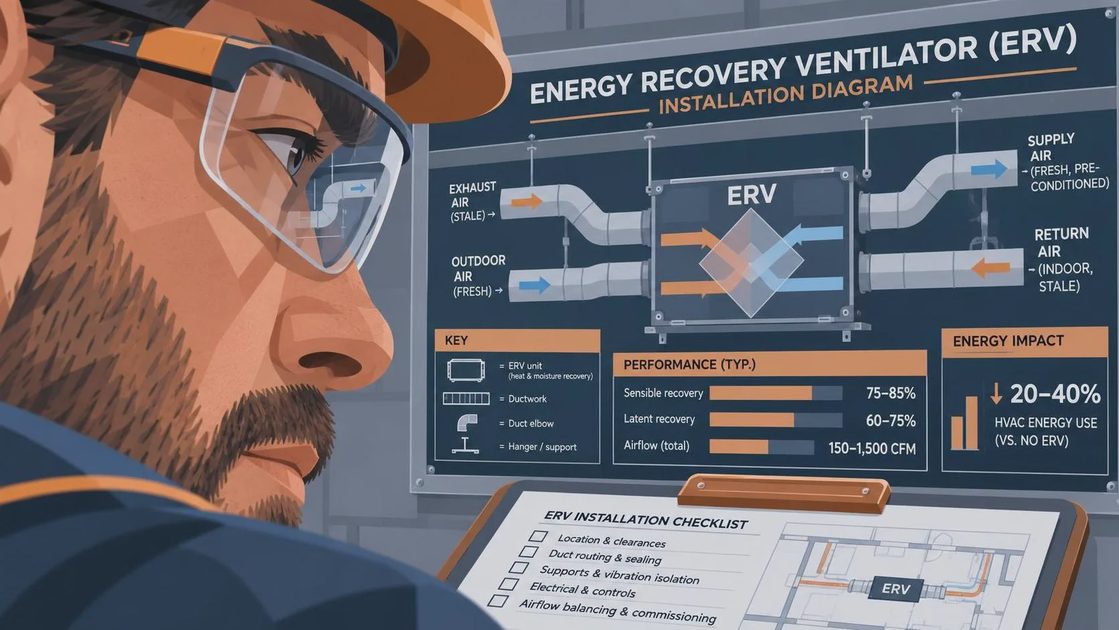
Those figures are not a menu you can add up to get a guaranteed total. Local labor rates and the scope of each bid matter. Ask whether the price includes two exterior penetrations, electrical power, condensate handling if required by the manufacturer, startup, airflow testing, and patching. A cheap proposal that leaves a painter and drywall contractor for you to hire is not necessarily cheap.
Also ask for the cost of replacement filters and how often the manufacturer recommends checking them. A unit tucked behind a finished ceiling with no practical service access is a maintenance bill waiting to happen.
Choose the duct route before choosing the unit
A typical erv installation needs a path for outdoor air into the unit, a path for exhaust air outdoors, and connections to deliver and collect air inside. Depending on the design, the indoor runs may be dedicated ducts or may connect to an existing forced-air system. Each approach has trade-offs.
Dedicated ducts give the designer more control over where fresh air goes and where stale air is collected. They also take space that an old house may not have. An attic, basement, closet, or dropped hallway ceiling can provide a route, but the contractor should show you where ducts will actually fit before quoting the job as straightforward.
Connecting to existing HVAC ductwork can reduce the amount of new ducting, but it is not automatically cheaper or better. The design must account for how the furnace or air-handler fan operates, whether the ERV can distribute air when that fan is off, and the added energy and noise if the larger fan must run. Have the contractor follow the ERV and HVAC equipment instructions rather than improvising a connection.
Outdoor intake and exhaust openings also need proper separation and locations away from contamination sources. Local code and manufacturer instructions govern the details. I would want to see both locations marked on the house before a hole saw comes out, particularly near a driveway, gas vent, or property line.
Sizing, balancing, and old-house safety
A good erv installation starts with an airflow calculation, not a guess based on square footage alone. The contractor should explain the intended ventilation rate in cubic feet per minute, or CFM, and account for the house, occupants, applicable code, and equipment instructions. The unit also needs enough capacity to deliver that airflow against the resistance of the actual ducts and filters.
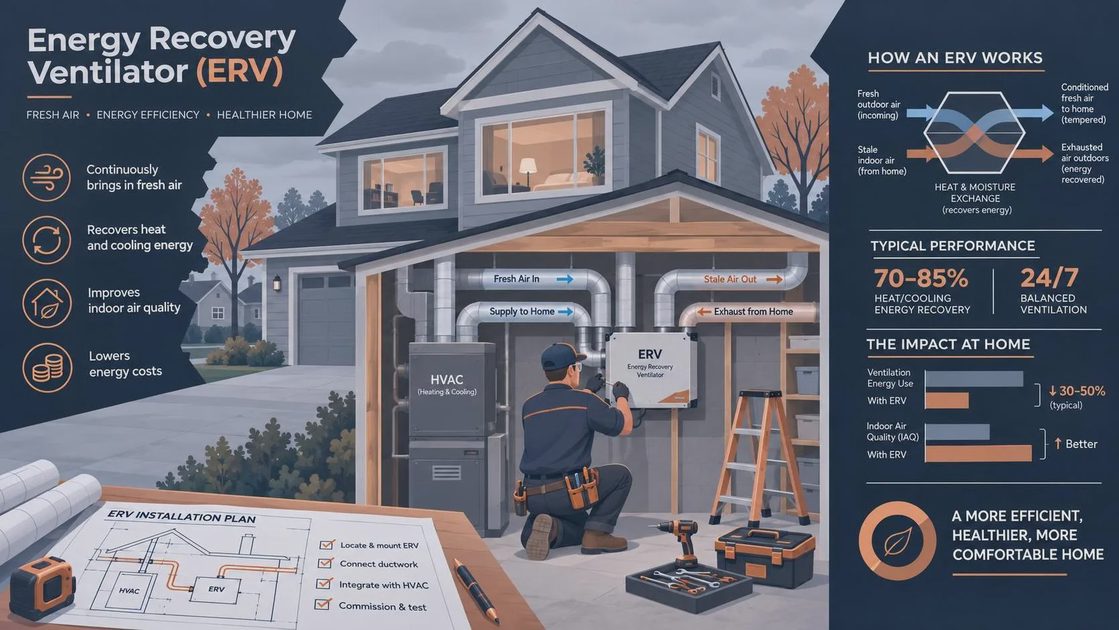
Once it is running, the contractor should measure supply and exhaust airflow and adjust the system as the design and manufacturer require. Ask for the measured numbers in writing. A fan that turns on is not proof that the bedrooms are getting the intended ventilation or that the two streams are reasonably balanced.
Combustion appliances deserve particular attention. A house with an atmospheric-vented water heater, furnace, or fireplace can be vulnerable to backdrafting when exhaust devices depressurize it. The installer should assess the whole setup, including bath fans and the range hood, and involve a qualified combustion professional where needed. Never treat an ERV as permission to skip working carbon monoxide alarms.
In older homes, disturbing plaster, paint, insulation, or duct materials can also uncover lead or asbestos hazards. Do not sand, cut, or remove suspect material casually. Have it evaluated and handled under applicable rules before the duct crew starts opening things up.
What to settle before signing
Get two or three bids based on the same scope. Ask each contractor to identify the equipment location, duct routes, exterior openings, controls, electrical work, permits, finish repairs, and commissioning measurements. Confirm who handles each item and what happens if framing or an old duct blocks the planned route. Get it in writing. Always.
Before the crew leaves, have them show you how to change filters, access the core, operate the controls, and recognize a fault. Keep the manual and the measured airflow figures with the invoice. Your next move is to walk the house with a ventilation contractor and mark a plausible equipment location and both outdoor openings before asking for a final price.

No comments yet — be the first to share a thought.