
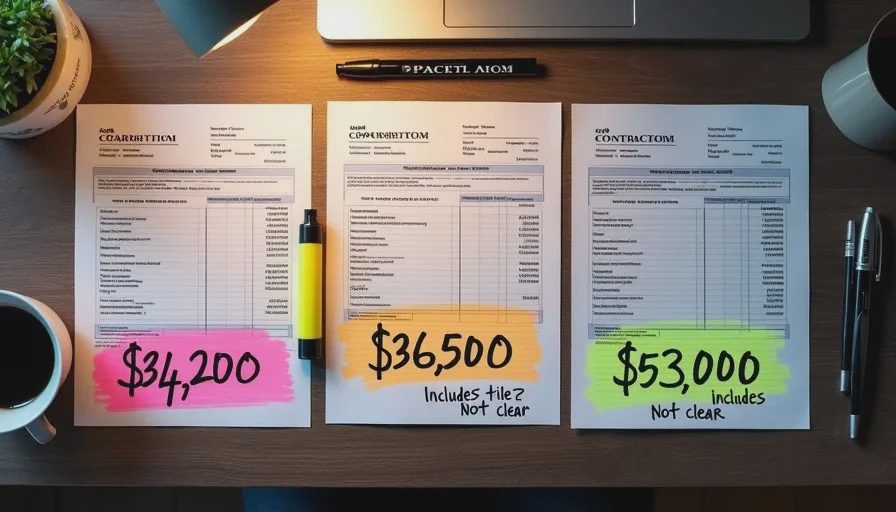
I get this question all the time: "Ryan, my neighbor redid their kitchen for $34,000. My quote is $52,000. Am I getting ripped off?"
Sometimes the answer is yes. Usually it's no.
Here's the truth about renovation bids: unless you're comparing identical houses, identical scopes, identical materials, and identical timelines, the numbers are going to be different. Sometimes wildly different.
And the people who assume the lowest bid is the best deal? They're the ones who end up calling me six months later asking for help fixing someone else's shoddy work.
What's Actually in a Bid
I'm going to break down what goes into a real renovation bid. Not the "we'll do it for this much" verbal quote from a guy who showed up in a pickup truck. A real bid from a licensed contractor who carries insurance and pulls permits.
Labor vs. Materials
Every bid is some combination of labor and materials. Typically, labor is 55% to 65% of the total. Materials are 35% to 45%. That's industry-standard.
If a bid has labor at 80% of the total, you're paying for inefficiency. If labor is 40%, the contractor is either using very cheap materials or they're cutting corners somewhere.
Overhead and Profit
Every contractor has overhead—insurance, licensing, vehicle maintenance, office expenses, workers' comp. A legitimate contractor's overhead runs 15% to 25% of their revenue.
Profit on top of that? 10% to 15% is standard. Anything less, and they're not staying in business. Anything more, and you're paying for their boat.
The Three Big Variables
Here's where bids diverge:
1. The Scope of Work
Your neighbor's $34,000 kitchen might include:
Stock cabinets from a big box store
Laminate counters
Basic vinyl flooring
Keeping the existing electrical and plumbing
A 10-day timeline with two workers
Your $52,000 kitchen might include:
Semi-custom cabinets with soft-close
Granite counters
Tile flooring
New electrical circuits for appliances
Relocating plumbing for a new sink location
A 15-day timeline with four workers
Those are two different projects. The $52,000 isn't a rip-off—it's just a bigger scope.
2. The Contractor's Overhead
A contractor who's been in business for 20 years, has a full-time office staff, pays for comprehensive insurance, and runs two crews? Their overhead is higher. They charge more per hour.
The guy who works alone, carries the minimum insurance, and does all the estimating from his kitchen table? His overhead is lower. His bid is lower.
Here's the thing: the higher-overhead contractor is more likely to show up on time, have the right insurance if something goes wrong, and be around in five years if you have a problem. You're paying for stability.
3. The Timeline
If you need it done fast, you'll pay more. Contractors juggle schedules. If you need them to start next week instead of next month, they're going to charge a premium.
If you're flexible, you can save 10% to 15%. If you're not, you'll pay for the flexibility you're taking away from their schedule.
The "Low Bid" Trap
Here's what often happens with the lowest bid:
The contractor underbid to get the job, and they cut corners to make a profit
They're not licensed and don't pull permits
They use subcontractors who aren't properly insured
They disappear when things get complicated
They change the price halfway through with a "change order" that was actually part of the original scope
I've seen it hundreds of times. A homeowner gets three bids. The lowest is $20,000. The middle is $26,000. The highest is $32,000.
They take the $20,000 bid. The contractor starts work. Week three, the contractor says, "We found a problem. It's going to be an extra $6,000." Week five, another $4,000. Week seven, the contractor doesn't show up anymore.
Total cost: $30,000. And the work is worse than what the middle bid would have produced.
How to Compare Bids Properly
If you want to know if your $52,000 bid is fair, you need to do this:
Get three bids. At least three. And don't tell any of the contractors what the others quoted. Let them give you their number independently.
Compare the line items. Don't just compare the total. Look at what each contractor is including. Are the materials comparable? Is the labor estimate similar? Is the timeline realistic?
Check references. Call the references. Ask about timeline, budget, and whether they'd hire the contractor again. If someone says "he was fine but..."—that's a red flag.
Ask about permits. If one contractor says you don't need a permit and another says you do, the one who says you don't is either wrong or cutting corners.
Trust your gut. If you get a bad feeling about the low bid, trust it. Your gut is usually right.
What's Reasonable in 2026
For the Pasadena market in 2026, here are rough ranges for typical renovations:
Project | Typical Range |
|---|---|
Kitchen (mid-range, 150 sq ft) | $35,000 - $55,000 |
Bathroom (mid-range, full bath) | $18,000 - $30,000 |
Master suite addition (200 sq ft) | $70,000 - $100,000 |
Foundation repair (pier and beam) | $10,000 - $25,000 |
Roof replacement (2,000 sq ft) | $12,000 - $18,000 |
Electrical panel upgrade (200 amp) | $3,500 - $5,500 |
These are rough numbers. Your actual cost will depend on scope, finishes, your zip code, and how much you do yourself.



No comments yet — be the first to share a thought.