The honest answer to how to insulate walls in existing home is that you usually cannot solve it from one side with a magic spray foam product. The wall cavity, exterior siding, wiring, plumbing, paint, and local climate all matter. I have opened enough old walls to know the cheapest-looking option is rarely the least expensive. Before buying materials, determine what is actually inside the wall and whether moisture is already getting in.
For a typical 1,500-square-foot house, wall insulation can cost anywhere from $3,000 to $15,000, depending on access and the finish work. Adding insulation during a planned remodel is usually the best value. Paying to remove perfectly good drywall, drill hundreds of holes, and repaint afterward is where budgets get ugly.
Start with the wall, not the insulation
If the house was built before the 1980s, assume the insulation is inconsistent until proven otherwise. Some walls will contain fiberglass batts, some will contain loose-fill insulation, and some will contain nothing but dust and old newspaper. In my 1923 Craftsman, one bedroom wall had decent insulation while the adjacent wall had an open cavity around an original window. The room felt cold because of the weak section, not because every wall failed.
Remove one electrical cover plate and look into the cavity with a flashlight or inexpensive inspection camera. Do not poke around carelessly near wiring. You are looking for insulation depth, gaps, signs of rodents, black staining, damp sheathing, and knob-and-tube wiring. A small exploratory opening behind a baseboard is also useful before committing to a full wall strategy.
Seal obvious air leaks first. Gaps around windows, doors, baseboards, outlets, and plumbing penetrations can make an insulated wall feel drafty. A few tubes of quality acrylic-latex caulk, low-expansion window foam, and outlet gaskets often deliver more comfort per dollar than adding insulation to a wall that leaks air around its edges.
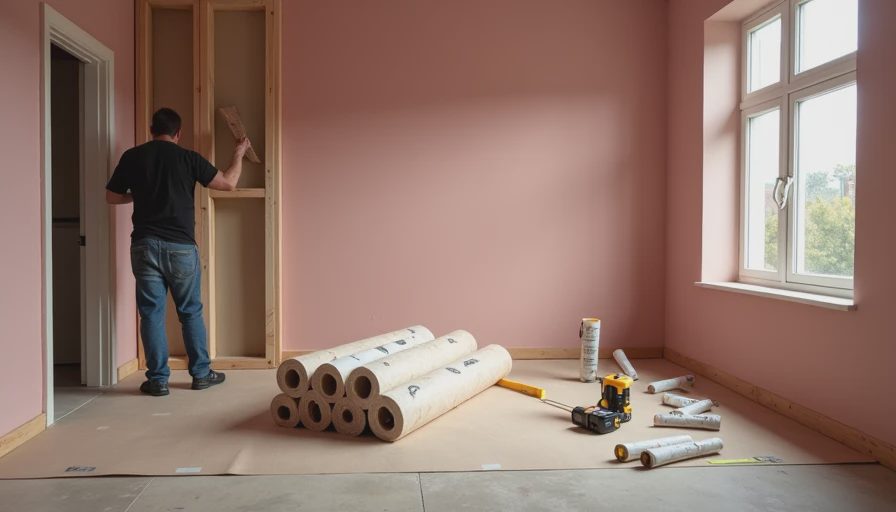
How to insulate walls in existing home without removing drywall
The most common retrofit method is drilling small holes between studs and blowing in dense-pack cellulose or injecting slow-rise foam. The installer normally removes a siding course or drills through interior drywall, fills each cavity, and patches the access points. Cellulose is usually the lower-cost choice, often around $1.50 to $3.50 per square foot of wall area before extensive repairs. Injection foam can run roughly $2.50 to $6 per square foot.
Dense-pack cellulose is my usual first quote for an enclosed wood-framed wall that is dry and accessible. It handles irregular cavities better than fiberglass and adds some air resistance when installed correctly. It does not stop bulk water, fix rotten framing, or make a wall vapor-proof. The installer must verify that the material reaches the bottom, corners, and areas around windows.
Injection foam can work well when the installer has experience with older construction. It expands gradually, which reduces the risk of bowing drywall compared with high-expansion spray foam. Still, foam is not a cure for a wet wall. If the exterior flashing is wrong, you need to fix the water path before filling the cavity.
Get the proposal in writing. Always. It should state the insulation type, coverage area, access method, patching responsibility, warranty, and how the crew will handle blocked cavities. A bid that says “insulate walls” is not a scope of work.
When opening the walls is the better deal
If you are replacing electrical wiring, moving outlets, repairing plaster, or remodeling a bathroom, open the walls and insulate properly while they are exposed. This is how to insulate walls in existing home when you want the best inspection and the fewest hidden surprises: remove the finish, repair framing, install insulation, air-seal penetrations, then close the wall.
For a standard 2-by-4 wall, unfaced mineral wool or fiberglass batts are familiar choices. Mineral wool is stiffer and easier to fit neatly around wiring, while fiberglass is usually cheaper. In a 2-by-6 wall, you have more room for insulation, but do not compress a batt designed for a different cavity. Compression and sloppy cuts reduce performance.
The line-item cost for insulation itself might be only $1,000 to $3,000 in a modest remodel. Demolition, drywall, taping, texture, paint, trim removal, and disposal can add $5,000 to $12,000. That is why wall insulation makes sense during a larger project but often does not justify tearing open finished rooms by itself.
The old-house problems that change the plan
Old homes need more inspection than enthusiasm. Plaster walls can crack when drilled. Wood siding can split around access holes. Brick veneer needs careful detailing around penetrations. Historic homes may also have narrow cavities, balloon framing, asbestos-containing materials, or outdated electrical systems.
Do not bury active leaks, termite damage, or mold behind new insulation. Fix the roof, gutters, flashing, plumbing leak, or grading problem first. If you see extensive staining or suspect asbestos in plaster, flooring, or insulation, stop and bring in the appropriate professional. A respirator and optimistic attitude are not a hazardous-materials plan.
For how to insulate walls in existing home projects, climate matters too. In a hot, humid region, the wall assembly needs to dry in the right direction and avoid trapping interior moisture. In a cold climate, air sealing and vapor-control details become more important. California houses still need careful moisture management, especially where air-conditioning creates cool interior surfaces.

A realistic project budget and sequence
Here is the sequence I would use for a 1,200-square-foot older house. First, spend $150 to $400 on inspection openings and an energy assessment if the contractor cannot explain the existing assembly. Second, repair exterior water and air leaks, budgeting $500 to several thousand dollars depending on windows, siding, and flashing. Third, get two or three bids for dense-pack cellulose or injection foam.
A straightforward retrofit might look like this: $3,000 for dense-pack cellulose, $1,200 for access and patching, $800 for air sealing, and $1,000 for paint touch-up. That puts the practical total near $6,000. A full interior tear-out could easily reach $15,000 or more once finish work is included. The cheapest estimate often leaves out patching, trim, electrical complications, or cleanup.
Ask each contractor how they confirm cavity fill. Some use measured material quantities, thermal imaging, inspection holes, or a combination. Thermal imaging is useful for finding missed sections, but it is not proof by itself; temperature differences, wind, and sunlight can distort the picture.
What I would do in your house
If the walls are dry, the siding is coming off, and the framing is ordinary wood construction, I would price dense-pack cellulose first. If a room is already being opened for wiring or plumbing, I would use that access and install properly fitted batts or mineral wool. I would not hire someone to drill a wall full of holes based only on a low price.
The practical lesson from how to insulate walls in existing home is simple: find the gaps, control water, air-seal the boundaries, and choose the insulation after you understand the assembly. Insulation cannot compensate for bad flashing or careless installation.
Your next move is concrete: cut one small inspection opening in an inconspicuous location, photograph the cavity, and get bids that identify the wall construction and every patching cost. That ten-minute investigation can keep you from paying for the same wall twice.

No comments yet — be the first to share a thought.